Santa Barbara emerges as tech titan thanks to UCSB and Google Quantum AI
t’s not just Amazon and Google. The South Coast is seeing a range of tech companies taking hold — often sprung from the University of California, Santa Barbara
by Chris Woodyard • Santa Barbara News-Press
Santa Barbara and Goleta are emerging as top destinations for tech companies.
The South Coast’s emergence has come largely from cutting-edge companies clustering around the latest technologies, from computing and lasers to infrared radiation and space engineering. Many were hatched from or later develop ties to the UC Santa Barbara.
Anchoring the local tech community is one of the nation’s best-known tech powerhouses, Google. The tech giant chose the area in 2013 as the home of Google Quantum AI, an endeavor created to develop a new generation of vastly faster and more capable computers.
Erik Lucero, lead quantum engineer for Google in Santa Barbara, credits “great neighbors and support from the local community, all of which has helped us grow in our leadership and mission to build best-in-class quantum computing for otherwise impossible problems,” in a statement to the News-Press.
It’s not just Google that’s found the South Coast welcoming. Grassroots growth is coming from promising startups that are morphing into industry leaders in their own right.
Lucidian, Curvature and Blue Laser Fusion are examples of companies that are becoming known for innovation in their respective fields.
“Santa Barbara and Goleta have a great start-up technology ecosystem,” Shuji Nakamura, a Nobel laureate and founder of Blue Laser Fusion, told the News-Press. “There are office spaces and labs and a trained workforce who can develop the technology and can keep facilities running smoothly.”
The Santa Barbara South Coast Chamber of Commerce has actively sought to lure firms to the join the local tech community by marketing Santa Barbara and Goleta as having a distinctive identity.
To create an aura, the chamber bestowed a moniker on the local tech community borrowed from its annual tech summit: TechTopia. The goal was to “try to create this brand that will allow us to attract more companies to come to this area,” said chamber spokeswoman Mary Lynn Harms-Romo.
<trimmed>
Collaboration creates jobs and success
Companies say collaboration has not only allowed them to develop new products, but continues the funneling of promising students from the university to the industry.
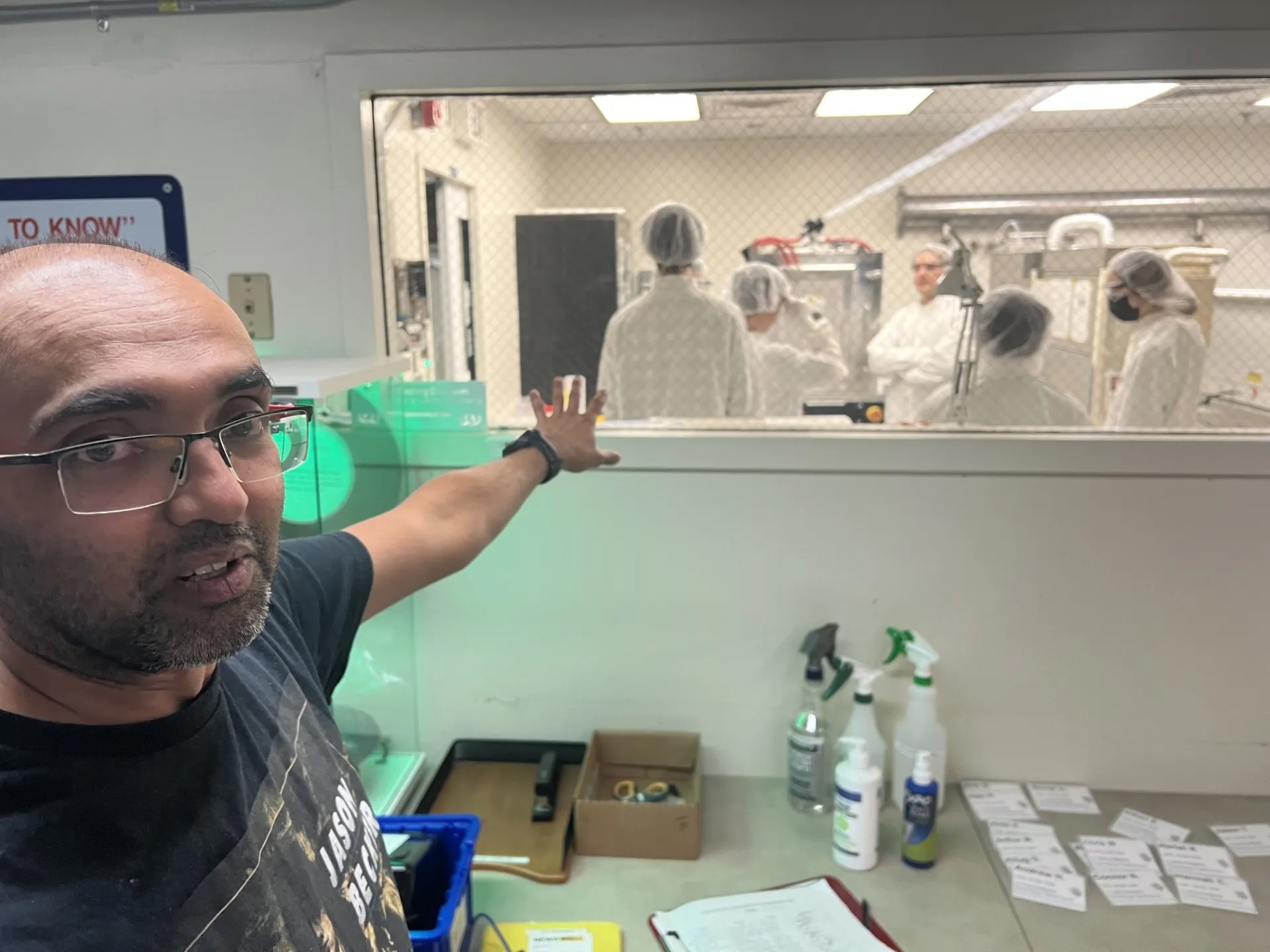
“For Blue Laser Fusion, several of our early employees came out of UCSB and we use the UCSB NanoFab cleanroom for some of our critical technology development,” Nakamura said.
Nakamura has served on the faculty at UC Santa Barbara and shared the Nobel Prize for Physics in 2014 for his role in inventing blue LED light. It was the critical missing piece need to develop the white, energy-saving LED bulbs that illuminate the world today. He founded Blue Laser Fusion to develop more powerful lasers that can be used to make fusion energy possible.
NanoFab isn’t the only concept aimed at commercializing UC Santa Barbara’s inventions . Another is an “innovation hub” called OASIS, which took over a building last October and plans to provide offices and support mostly for startups.
“We’re really thinking about OASIS as place to allow them to take the innovation done…really get them scaled up to the poinit they have a product in the market,” said Tal Margalith executive director for Strategic Initiatives and Operations for the college. He plans to start out with four firms, startups that usually have anywhere from five to 20 employees.
OASIS — it started as an acronym but now is just a name — plans to offer both office and lab space and maybe its own cleanroom in the future.
<trimmed>
Newspress image: Prashant Srinivasan, a teaching clean room engineer, points out the students gathered to learn to make computer chips at UC Santa Barbara (Photo by Chris Woodward/Santa Barbara News-Press)