UCSB researchers use distributed Bragg reflectors to dramatically increase light output and improve beam convergence in microLED devices
Researchers at the University of California, Santa Barbara, have designed a microLED with an increased beam spread and efficiency, that could replace traditional lasers in short-range data communication or display applications.
The researchers used distributed Bragg reflectors to laterally enclose the emitting region of the LED, and thus engineer the light emission. This new microLED architecture increased the emission output by 130% from the substrate side and 20% from the air-side, when compared to standard reference devices. The researchers also reported a 30% reduction in beam divergence.
The researchers say that beyond the directional accuracy, the modified microLEDs demonstrated improved power handling, with a reported 35% increase in electrical efficiency and a 46% improvement in wall-plug efficiency.
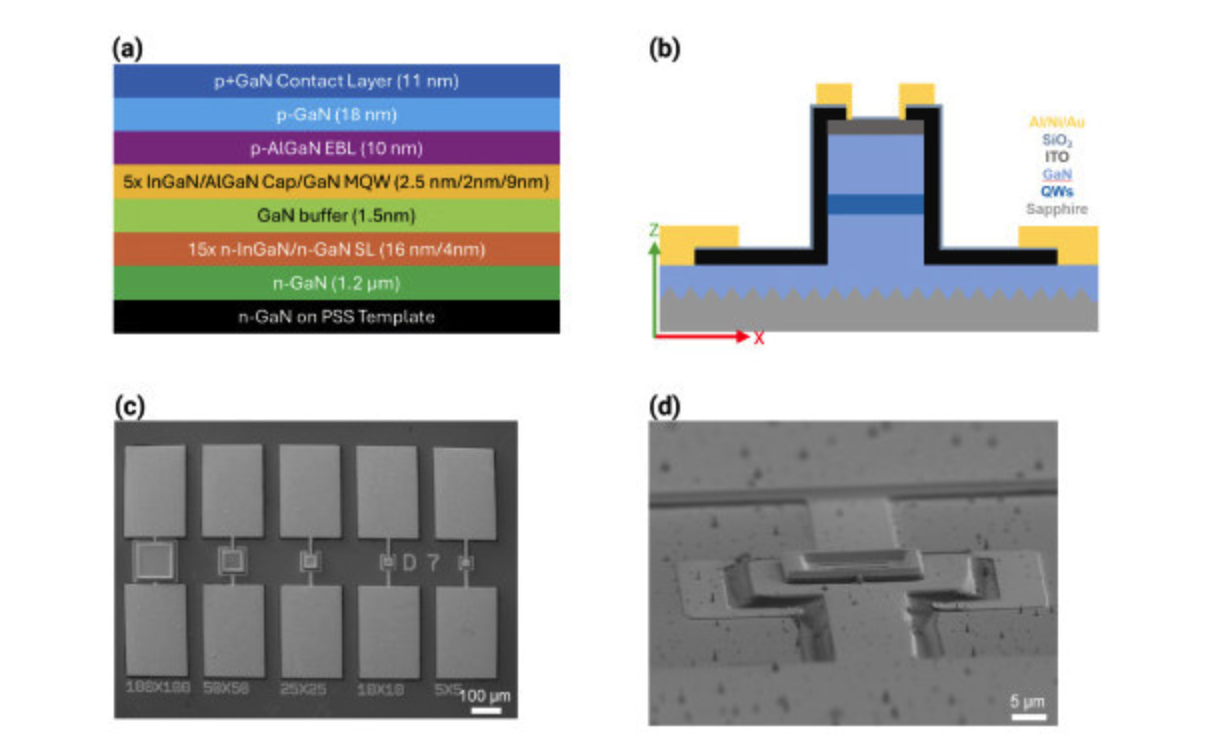
Fig. 1. (a) GaN LED device stack for operation around 440 nm. (b) 2D cross section schematic of the AMµLED architecture. Only the insulator region differs between the two compared designs. In the TiO2 µLED, the emitting mesa is enclosed by a 300 nm TiO2 layer. In the DBR design, the emitting mesa is enclosed by an 8.5 period DBR consisting of TiO2 and SiO2. (c) Overhead SEM image of the fabricated devices. The labels correspond to the air-side aperture, not the mesa size. (d) Angled SEM image of the 10 × 10 µm air-side aperture device (corresponding to the 20 µm device), clearly depicting the annulus. “Spiking” arises from Cl2 etch chemistry.
Source: Optica
Posted: Feb 24,2026 by Ron Mertens